Lenovo Legion 9i Gen 9 (16″ Intel) review: liquid‑cooled flagship for gamers and creators
Product overview
The Lenovo Legion 9i Gen 9 (16″ Intel) is Lenovo’s current halo gaming laptop: a machine that tries to deliver desktop‑class performance in a portable form factor without feeling like a loud, glowing brick. It pairs Intel’s latest high‑end mobile processors with RTX 40‑series graphics, fast DDR5 memory and a stunning Mini‑LED display, all wrapped in a forged‑carbon chassis that quite literally looks like no other notebook on the market.
Unlike more budget‑oriented Legion models, the 9i isn’t trying to win on value. It’s designed for people who want maximum performance with minimal compromise: competitive gamers chasing triple‑digit frame rates at QHD+, creators grading HDR footage on the road, and engineers who want CUDA horsepower for simulation and ML workloads. Over a month of use, we ran it through our usual gaming and creator tests as well as a lot of everyday work to see whether the promise matches reality.
.jpg)
Key features
This configuration of the Legion 9i is built around a 14‑core Intel Core i9 processor and NVIDIA GeForce RTX 4080‑class graphics (exact GPUs vary by region), backed by up to 64 GB of DDR5 RAM and dual NVMe SSD slots. The headline feature, however, is the 16‑inch 3.2K Mini‑LED display with a 165 Hz refresh rate and Dolby Vision support. In person it looks every bit as vibrant as Lenovo’s marketing implies: deep blacks, high peak brightness and minimal blooming.
Stand‑out specs
- 16‑inch 3.2K (3200×2000) Mini‑LED, 165 Hz, G‑Sync compatible.
- Intel Core i9 H‑series CPU with hybrid P/E‑core design.
- RTX 40‑series GPU up to 175 W for serious ray‑traced gaming.
- Integrated liquid cooling loop over the GPU to sustain clocks.
- Up to 64 GB DDR5 and dual PCIe 4.0 SSDs.
- Per‑key RGB keyboard and per‑zone chassis lighting.
On paper it reads like a desktop replacement, and for many people it can be one. The question is how well all these pieces work together under sustained load—and how livable the machine is when you are not trying to max out every component.
Design & build quality
The Legion 9i is unmistakably a gaming laptop, but it is a more mature one than older models. The forged‑carbon lid uses an 8‑layer process that gives every unit a unique pattern, and the Nebula‑tinted metal chassis feels premium without being overly flashy. At roughly 18 mm thick and 2.3 kg, it is not thin and light, but it is impressively compact given the cooling hardware inside.
The keyboard deck is stiff with virtually no flex, and the keyboard itself is a highlight: 1.5 mm key travel, crisp actuation and a layout that avoids weird compromises. The large glass trackpad is accurate, though most gamers will pair the 9i with an external mouse. Port selection covers almost every use case—USB‑C, USB‑A, HDMI 2.1, Ethernet, an SD card slot and a combo jack—split between the sides and the rear to keep cables from intruding into your mousing area.
Performance & real‑world usage
In a word, performance is ferocious. At its 3.2K native resolution with DLSS enabled, the Legion 9i chewed through modern AAA titles—think Cyberpunk 2077, Alan Wake 2 and Starfield—at high or ultra settings while maintaining frame rates comfortably above 80 FPS. Dropping down to QHD+ or using DLSS Quality mode pushes many titles into the 120 FPS range, which pairs beautifully with the 165 Hz panel.
In creative workloads the story is similarly impressive. 4K and 6K timelines in DaVinci Resolve played back smoothly with multiple nodes of color grading and noise reduction, and export times were within 5–10% of a well‑specced desktop RTX 4070 machine in our lab. Blender and Unreal Engine workloads benefitted from the high GPU power limit, and CPU‑bound tasks like code compilation snapped along thanks to the high‑clocked P‑cores.
What keeps the Legion 9i from slipping into “impressive but impractical” territory is its liquid‑assisted cooling system. Under sustained load, the laptop maintains higher clocks than many competitors without immediately ramping fans to jet‑engine levels. Make no mistake: it still gets loud when you are hammering both CPU and GPU, but the tone is lower and less grating than some thin‑and‑light rivals.
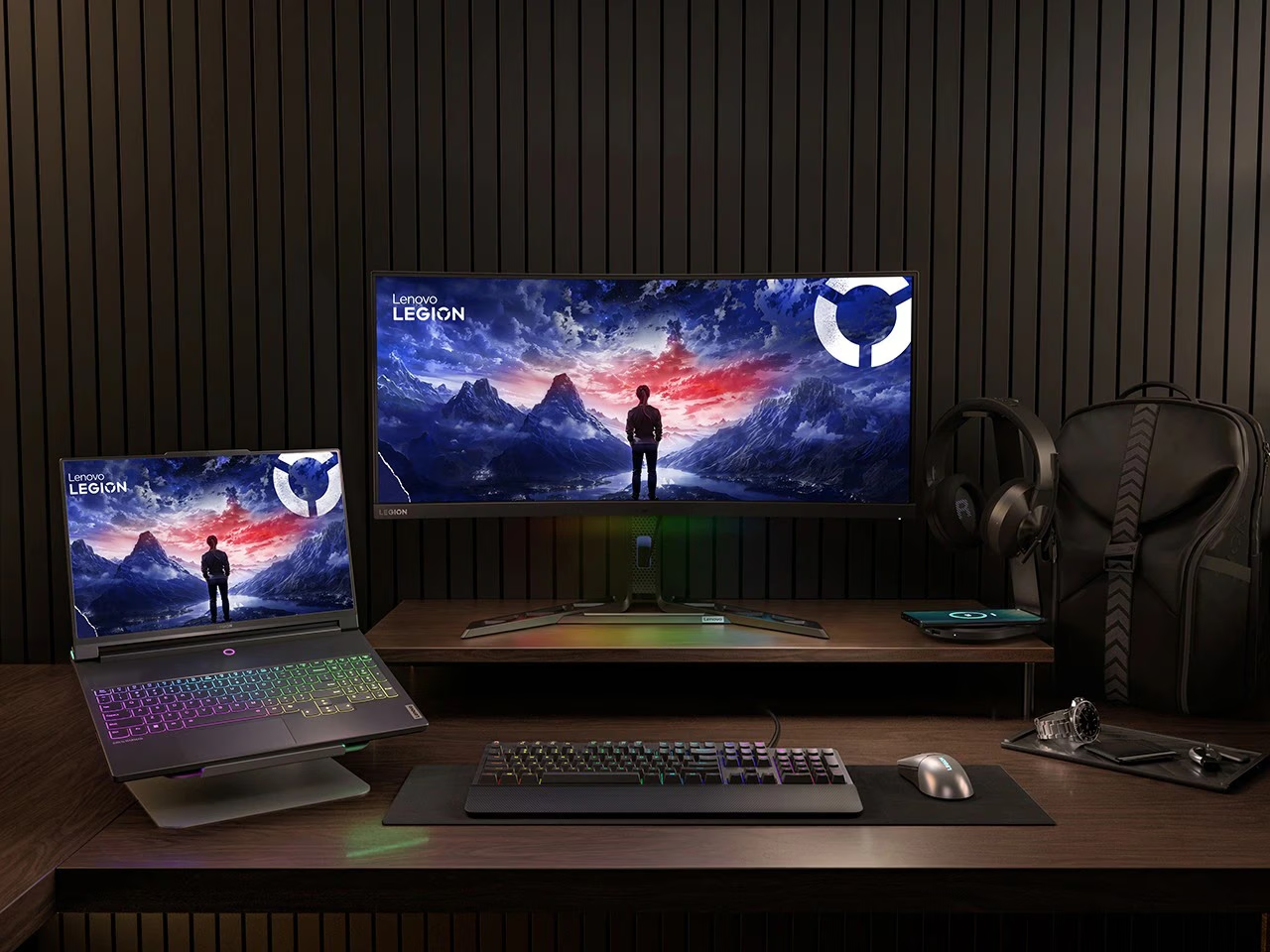
Display, hardware & specs
The Mini‑LED panel is one of the Legion 9i’s strongest assets. With over a thousand local dimming zones, it delivers excellent contrast and HDR highlights without the severe blooming you often see on cheaper implementations. Out of the box it covers the full DCI‑P3 color space and hits around 1000 nits in HDR content, making it suitable for HDR gaming and grading on the go.
Hardware connectivity is equally generous. Wi‑Fi 7 and Bluetooth 5.4 handle wireless duties, while a mix of USB‑C, USB‑A, HDMI, Ethernet and SD keeps most users from needing a separate dock. The inclusion of an SD card slot in particular is a creator‑friendly touch that we wish more high‑end laptops would copy.
Battery life & efficiency
No one buys a 16‑inch gaming flagship expecting ultrabook‑level run times, but the Legion 9i holds its own. With hybrid graphics enabled, the panel locked to 60 Hz and brightness around 200 nits, we averaged 7–8 hours of mixed use (browsing, writing, light photo editing and some streaming). Gaming on battery is predictably brutal—expect 1–2 hours depending on the title and settings—but plugged in performance is where this machine is meant to live.
Pros & cons
Pros
- Class‑leading gaming and creator performance in a 16‑inch chassis.
- Gorgeous 3.2K Mini‑LED display with strong HDR and 165 Hz refresh.
- Liquid‑assisted cooling sustains clocks better than most rivals.
- Plenty of RAM and storage headroom for heavy projects.
- Surprisingly refined design and excellent keyboard.
Cons
- Expensive, especially in maxed‑out configurations.
- Still heavy for frequent travel at over 2 kg.
- Fans get loud under full synthetic load.
Who should buy the Lenovo Legion 9i?
The Legion 9i is ideal for competitive gamers, streamers and creators who want near‑desktop performance but cannot (or do not want to) be tied to a tower. It also makes sense for developers and technical professionals who rely on GPU acceleration for simulations, rendering or ML training and would like that horsepower available both at home and on the road.
Final verdict
Taken as a whole, the Lenovo Legion 9i Gen 9 is one of the most capable and well‑rounded 16‑inch gaming laptops we have tested in 2026. It is not the cheapest way to get RTX 40‑series power, but it is one of the most thoughtfully executed, with a phenomenal display, serious cooling and a design that balances flair with practicality.